SMART Science
September 2008
It’s Cool To
“School”!
What do fish and children have in common? They have quite a few things in common, actually. Both are members of the animal kingdom, and both are vertebrates. Another thing they have in common is they both can often be found in a school. School for children and school for fish aren’t exactly the same thing, but they each involve a group. Some fish swim in large groups together. Why do you think they would do this?
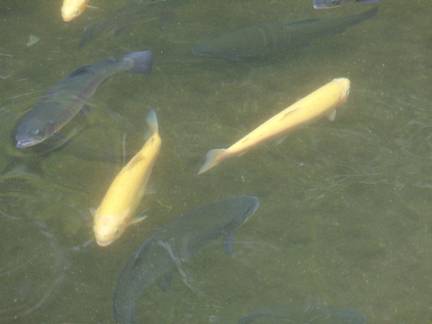
Golden rainbow and rainbow trout at Petersburg Trout Hatchery, Petersburg, WV
Sometimes a large group of fish might look like a really big fish to a predator. “Safety in numbers” is a phrase that could describe one reason why fish school together. Watching a school of fish is very interesting. When they move, they almost do seem like one big creature.
In June of this year when we (Robert and Libby Strong) were on vacation in the Galapagos Islands, we saw this type of schooling behavior up close. We were snorkeling and saw a school of beautiful silver fish dart quickly away, followed closely by a fast moving penguin! It was an amazing sight to watch, especially under water. The penguin moved like an underwater torpedo, but the school of fish was pretty fast, too. Watching the chase was something neither of us will forget.

Galapagos penguin on rocks
Galapagos penguins are only found around the Galapagos Islands. They depend on the cold-water currents that move northward from Antarctica. The Galapagos penguin is the only penguin that lives north of the equator. All other penguin species are found only in the southern hemisphere. For more photos of the Galapagos penguin and other Galapagos animals and scenery, visit www.smartcenter.org/ovpm/galapagos
For fun, think of other words used to describe groups of animals such as “school” describes a group of fish. Examples include a herd of cattle or flock of turkeys. Many types of animals are often found in groups. It is “cool to school”!
Robert E. Strong is the director of the West Liberty
State College SMART-Center, the hands-on science center of the Northern Ohio
Valley. Libby Strong is the
Program Coordinator at the West Liberty State College SMART-Center and also
directs the WV-Handle On Science Program that brings hands-on science kits to
the public school classrooms of the Northern Panhandle. Richard Pollack is the assistant
program coordinator, Webmaster, and technology specialist for the WLSC
SMART-Center. Robert, Libby, and
Richard invite you to visit the website at www.smartcenter.org