Go With The Flow!
The sound of water moving swiftly over rocks in a stream is pleasant and relaxing. If you place a toy boat in the stream, it will soon move in the direction of the flowing water. We say that the water carries the toy boat along or that the moving water pushes the toy boat with a force that moves it in the same direction as the moving water. For more water related fun, try saying the words “toy boat” over and over as quickly as you can – it is harder than you might think.
Toy Boat Stream Activities:
You will need:
1) a toy boat that floats. Be sure it is a toy boat that is ok to get scratched, broken, or even lost. Some streams can be rough on toy boats.
2) wear old clothes and shoes you don’t mind getting a little muddy. Wear old shoes, because when you step in the stream there may be glass on the bottom.
3) safe access to the bank of a local stream. Note: do not attempt this after it rains.
4) an adult to watch you while you watch the toy boat
5) snacks are optional, but cleaning up the area is not. Bring some bags for trash pick after the experimenting is over. If you are going to bring the bags anyway, put some snacks in them.
Now try to answer the following questions with your toy boat in the stream.
Question #1: What happens if you increase the amount of water flowing under your toy boat?
Question #2: What happens if you decrease the amount of water flowing under your toy boat?
Question #3: What happens to the sound that the water makes in Question #1 compared to Question #2?
Question #4: Does the depth of the water in the stream change the motion of your toy boat?
Question #5: Can you find a place in the stream where the toy boat is floating, but does not move along with the water?
We recommend that when you go down to a stream to perform the experiments / experiences stated above that you bring along an adult, not just for the obvious safety reasons if you should fall in, but to help carry the snacks. Experimenting can be hard work. Be sure to take back all your scraps of trash and take anything else that someone may have accidentally dropped the last time they visited the stream. This will help make the stream more beautiful each time you visit.
Stream Modeling:
If you do not have a stream handy, you can model the power of the moving water in a stream with the following activity.
You will need:
1) a working plastic pinwheel (like you use outside in the wind).
2) outdoor faucet as a water source (use yours not your neighbor’s).
3) garden hose attached to your faucet.
4) adult supervision – always a good idea, saves on the explaining afterwards if an adult is around. Besides, it really is more fun when you squirt them with water.
Procedure:
A) turn on a gentle stream of water.
B) place the pinwheel blades under the stream of water.
Question #1: What happens to the blades of the pinwheel?
Question #2: Leaving the water stream the same, do the pinwheel blades change speed when the water falls a greater distance on them? Try it.
Question #3: What happens to the speed of the pinwheel blades when you increase the flow of water?
Ask your own questions and see if you can answer them using your pinwheel.
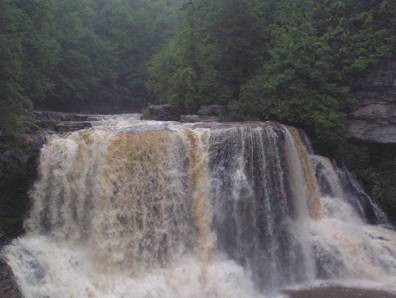
Blackwater Falls, Davis, WV (Photo by Robert E. Strong 2007)
Hydro Power is the name for water power, the power we get from moving water. Because moving water can move things and make things turn, humans have invented ways to use moving water to turn wheels to grind grains into flour as well as move cargo on rivers. The power of moving water can also turn turbines that generate electricity. Nearly 1/5 of the electricity generated in the world today comes from hydro power. Some companies like AEP have hydroelectric plants in different locations throughout the country. Hydropower doesn’t require the burning of fossil fuels like oil. This is an alternative energy source for producing electricity. Other alternative energy sources include wind power (see OVPM article April 2006 “Feel the Wind”), solar power, and geothermal power. To learn more about hydropower, visit
www.smartcenter.org/ovpm/hydropower
Libby and Robert Strong and Richard Pollack work at the West Liberty State College SMART-Center and invite you to visit the SMART-Center website at www.smartcenter.org