SMART Science
November 2008
Birthday Star
Have you ever asked your parents “Are we there yet?” when you were on a trip? Everyone knows it takes time to travel, but sometimes we wish we could travel faster. Light travels faster than anything we know, but even light needs time to travel from one place to the next. Astronomers use the time it takes light to travel from one object to the next to measure large distances in space.
Stars are very far away from the Earth. Our closest star, the Sun, is 93 million miles (or 150 million km) away. The light from the Sun takes over eight minutes to reach us on Earth. This means that the Sun is just over eight “light minutes” away.
The stars we see at night are also Suns but very, very far away. In fact the closest star, (other than our Sun) Proxima Centauri, is 4.24 light years away. This means that the light we see from Proxima Centauri left four and almost a quarter years ago. You need to live much further south of the Ohio Valley to be able to see the area of the sky where Proxima Centauri is located. Proxima Centauri is a small, dim, cool, red star that can only be seen through a telescope. Small, dim, cool, red stars are the most common kinds of stars in the universe. The Sun is a big, bright, and hot star. Stars like our Sun are rare. Rarer still, are stars that are even bigger, brighter, and hotter than our Sun.
If you are just over eight and a half years old, there is a star you could call your “birthday star”. This star is Sirius. Sirius is the brightest star in the nighttime sky. Sirius is just over 25 times brighter than our Sun. It is has 5.6 times the volume of our daystar and has twice its mass. The light from Sirius takes 8.58 years to leave the surface of Sirius, travel through space, and reach Earth.
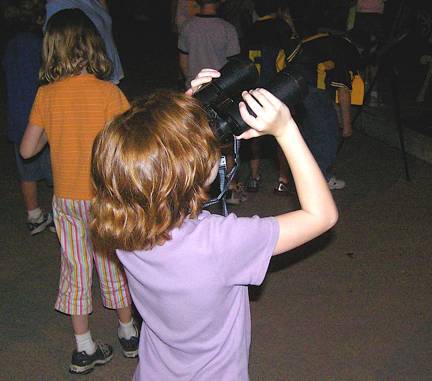
Maggie Childers with Binoculars at a StarWatch
Sirius, or the Dog Star, is found in the winter constellation Canis Major – the Big Dog. Canis Major is a constellation of stars close to Orion, the Hunter. If you can find Orion in the Sky, look below and to the east to find Canis Major. Star hopping is a great way to find Sirius if you see Orion in the sky. Find the three stars in the belt of Orion and follow a line slightly down and to the east about eight times the width of Orion’s belt and you will find Sirius – the brightest star in the nighttime sky. In Greek mythology, Canis Major was Orion’s faithful companion and hunting dog. Both constellations are best seen from the Northern Hemisphere in the evening in late fall and winter months. For those of us here in the Ohio Valley, Sirius rises in late November around 10:00 p.m..
For
more information on other birthday stars, astronomy photos, and interesting
related links, visit www.smartcenter.org/ovpm/birthdaystars
Birthday Star Activity:
1) Find Canis Major in the evening sky.
2) Watch the constellation every clear evening.
3) Notice where the constellation is located in the sky.
4) Does Sirius change position each night?
5) Try going out at the same time each night for a month and chart where the constellations are located.
For more family astronomy fun, visit Robert, Libby, and Richard at the monthly StarWatch held at Brooke Hills Park. These monthly public StarWatches are free and held at the Cardinal Shelter during the warmer months and at the Brooke Hills Park Club House for the months of November, December, January, and February. The members of the local astronomy club ASTROLABE, the members of the Near Earth Object Foundation and the staff of the West Liberty State College SMART-Center will be on hand with telescopes to guide the public into the fascinating wonders of the night sky.
Robert E. Strong is the director of the West Liberty
State College SMART-Center, the hands-on science center of the Northern Ohio
Valley. Libby Strong is the
Program Coordinator at the West Liberty State College SMART-Center and also
directs the WV-Handle On Science Program that brings hands-on science kits to
the public school classrooms of the Northern Panhandle. Richard Pollack is the assistant
program coordinator, Webmaster, and technology specialist for the WLSC
SMART-Center. Robert, Libby, and
Richard invite you to visit the website at www.smartcenter.org