OVPM March
2010 SMARTScience
March
of the Dinosaurs
There is a
saying that March may “come in like a lion and go out like a lamb”. What would it be like if March came in
like a dinosaur? How did the
dinosaurs walk? Did they run? How long is the length of your step
compared to some of our favorite dinosaurs? How does your mom or dad’s step compare?
You can
compare the length of your steps to the length of the steps of some famous
dinosaurs by doing the following activity. You will need:
1) large room
or outside on the sidewalk
2) masking
tape or sidewalk chalk
3) meter tape
or meter stick
4) cardboard
or heavy paper to cut out footprint stencils
5) scissors
6) pencil
7) paper
What to do:
Step 1: Have
your mom, dad, or an older relative or friend help you. Science is always fun to do together.
Step 2: If you
do the activity inside, make sure you have room to walk for a short distance
(several steps). For the inside
activity, you can mark your steps with a small piece of masking tape. If you choose to do the activity
outside and you have permission, you can mark your steps with sidewalk chalk.
Step 3: Walk
normally for a few steps. After
each step, have your adult helper mark where you stepped. You will need to mark where your foot
started and where it moved (two marks—the starting line and the first
step).
Step 4:
Continue to walk for a few more steps.
Mark each step with tape or with sidewalk chalk.
Step 5: With
pencil, write your name on the masking tape or have your adult helper write it
for you. If you are outside on the
sidewalk and using sidewalk chalk, you can write your name in sidewalk chalk
also.
Step 6: Have
your adult helper also walk normally for a few steps and repeat the activity by
marking where the steps are. Your
adult helper should also write his or her name on the masking tape that marks
his or her steps.
Step 7: With
the meter tape or meter stick, measure the distance between your steps. Write this down on your paper or have
an adult help you.
Step 8:
Measure the distance between your adult helper’s steps and write this number
down as well.
Step 9: Who had the longer steps?
Step 10: You can also trace your foot and your
adult helper’s foot on cardboard or heavy paper. Cut out the traced foot and place the “feet” where your
footprints were.
Now imagine
that you are a Tyrannosaurus Rex (T. rex) and you are walking around trying to
find your supper. How long would
the step of a T. rex be? To find
out, try the following activity.
You will need the same materials that you used in the first activity.
Step 1) Mark
the floor or the sidewalk with a starting point and label it “T. rex”.
Step 2)
Measure 4.6 meters (15 ft) from the masking tape labeled “T. rex” and your new
mark. This was the length of a T.
rex footstep! A T. rex may have been
able to run up to 24 kilometers per hour (15 miles per hour). This dinosaur was over 6 meters (just
under 20 feet) tall and 12 meters (about 39 feet) long and may have weighed
over seven tons!
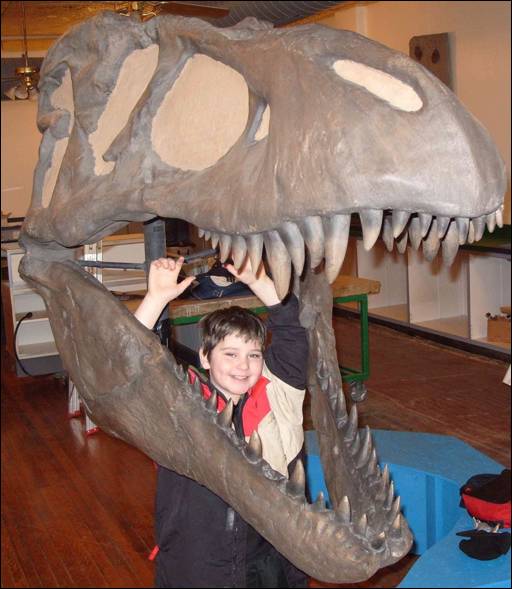
T. rex skull
replica and Sam Marshall, 4th Grade Corpus Christi, at SMART Centre
Market
Next, look at
the size of your footprint and your adult helper’s footprint that you traced
and cut out. If you measure it,
compare that size with the size of a T. rex footprint that was over 46 cm long
(1.5 feet)! A T. rex sort of
walked on its toes, so the actual foot was really over 1 meter long!
Another
dinosaur that you can compare your footprint size and the length of your step
with is the Coelophysis. The
Coelophysis was a very early dinosaur that was about 2.8 meters long (about 9
feet) and had a stride length of over .75 meters (2.5 feet). The Coelophysis footprint was about 10
centimeters (4 inches) long. You
can print off a stencil for the Coelophysis footprint at www.smartcenter.org/ovpm/dinosaurfootprint How does the Coelophysis footprint
compare to your footprint size and to your stride?
The
Coelophysis probably ran fast and may also have hunted in groups, although
paleontologists are not certain.
The winner of the SMART Centre Market’s Name Our Coelophysis contest used the idea that the
Coelophysis was a fast runner and named it “Fleet”. Another meaning for the word fleet is a group moving
together. Fleet can also mean
something that does not last long or is temporary. The winner of the contest is Shanaya Poling, a second grade
student from Rosanna Latacz’s class at Hilltop Elementary School in Marshall
County. Over 100 different names
were submitted to the contest. Our
judges had a difficult time deciding on the best name. Congratulations to Shanaya and her
teacher, Mrs. Latacz. Each of them
will receive a $50 gift certificate to use at the new science store, SMART
Centre Market, next to Centre Market in Wheeling.