Ohio Valley Parent article
March 2008
WLSC SMART-Center
“Go the Distance”
Webcams and distance learning
resources on the internet.
Next to curiosity, perhaps the most important tool needed to be a scientist is good observation. Observation is just another word for watching very closely. Everything that happens in the scientific process depends on you becoming a very good observer.
Preschool students at Our Lady of Peace School have been observing penguins and their habitat in the Antarctic region of our world, nearly 7,500 miles from Wheeling, West Virginia. They have been working on a Science project about penguins and weather. Even though it is summer at the South Pole, it wouldn’t be possible for them to visit in person. How did they do it? Everyday, as they directly observe local weather conditions out their window, they log on to the “Weather Page” at the www.smartcenter.org website. This page contains weather information and a web cam that allow them to observe a penguin colony in Antarctica, at Bernardo O’Higgins Station, which is maintained by the country of Chile. Each day the students count the penguins, check the temperature and weather conditions, and make observations about the penguin behavior and their habitat. They record all the information on a data sheet. After a few weeks, they will compare temperature at the colony, with the number of penguins they can count.
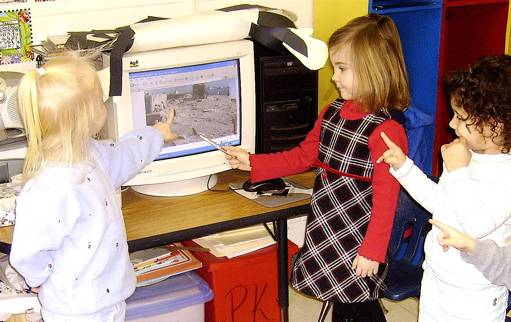
Our Lady of Peace Preschool students count penguins nesting in Antarctica.
It would be very hard to travel to Antarctica in person, and watch the penguins as they hatch eggs and raise their chicks. It is also important to know that the penguins would behave very differently if you were to show up in their nesting area with your notebook and camera! They might even think you are dangerous, and leave their nests and newly hatched chicks. Using science webcams, a form of distance learning, can allow for better observation and better data. You can make your observations without causing any disturbance.
How many penguins do you see in this webcam image? What can you tell about their habitat? Are they all the same size? What does it look like they are doing?
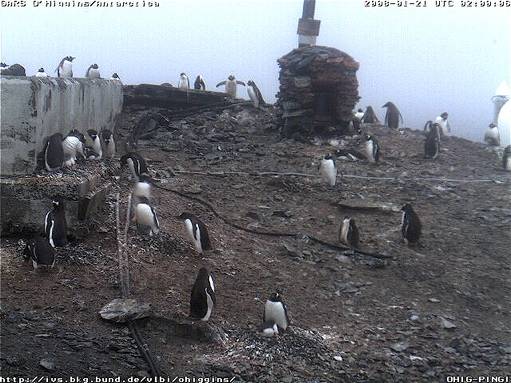
Webcam image of penguins at Bernardo O’Higgins Research Station Antarctica
Another very important advantage of science webcams is safety. Safety should always be at the very top of your list when doing good science. This means safety for you, AND for whatever you are observing. Observing with a webcam near an active volcano, or a tiger’s den is a much better idea than being there in person! You can even observe something as far away and dangerous as the very hot surface of the sun, and sunspots that are emerging, at this website: http://spaceweather.com/
As you are reading this article, scientists, naturalists, and students around the world are observing birdcams as many different species of birds began spring hatching. Go to this website for a list of birdcams. You can also check you favorite search engine for others. http://beakspeak.com/birdcams/
Many of the birdcams are set up to observe eagles nesting in North America. Some eagle nests in Florida and areas in the southern United States have already produced hatchlings. We are very lucky to have an excellent eagle nest birdcam here in West Virginia. The nesting pair of eagles has already begun preparing the nest, and will soon begin tending eggs that will hatch in early March. Visit this link to view the nest, and watch as the eagles tend the nest and eggs, waiting for the babies to hatch! Practice “good observation” and keep a journal of your data and observations. It might be fun to make sketches, and describe what you see in your own words.
http://www.fws.gov/nctc/cam/eaglecam.htm
Webcams, distance learning, or virtual resources should never replace direct observation or experiences, when that is possible and safe. “Virtual” observation should be a “tool” that you add to your own direct observation and experience. You can watch baby eagles in another part of the world on your computer screen, but it is actually better science, and more fun to observe the nesting birds in your “own back yard”.
Robert E. Strong is the director of the West Liberty State College SMART-Center, the hands-on science center of the Northern Ohio Valley. Libby Strong is the Program Coordinator at the West Liberty State College SMART-Center and also directs the WV-Handle On Science Program that brings hands-on science kits to the public school classrooms of the Northern Panhandle. Richard Pollack is the assistant program coordinator, webmaster, and technology specialist for the WLSC SMART-Center. Robert, Libby, and Richard invite you to visit the website at www.smartcenter.org