Optical Illusions
We have all heard the saying that “seeing is believing”. What if you saw something that you did not believe was true? Sometimes you can fool your brain into thinking that something is true when it is not. There are a number of images that scientists and artists have created over the years that do just that. We call these special brain-fooling images “Optical Illusions”. Optical Illusions can be one of the most interesting science experiments because they directly involve you. They are safe and only really exist within your own mind. Part of the fun of Optical Illusions is that everyone may not “see” the same illusion. Many Optical Illusions allow your brain to see two or more objects or ideas, but almost never at the same time.
What Happened To My Hand?
One of the most simple Optical Illusions is what we call “What Happened to My Hand.”
For this activity you will need:
1) a sheet of paper or an empty paper towel roll.
2) two eyes
3) your hand
4) distant wall or object to stare at
Use a paper towel roll or roll a piece of paper into a long tube of the same size. With both eyes open look through the tube with your right eye. Look at a far wall or a distant object with both eyes. Place your left hand against the left side of the tube, palm open and facing you. To better see this optical illusion effect, slide your hand away and toward you along the left edge of the tube. What do you see? Do your friends and family see the same thing?
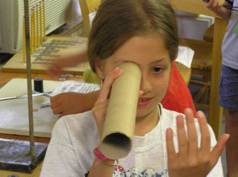
Jessica Hopkins of West Liberty Elementary
Build Your Own Optical Illusion
Many Optical Illusions use an effect called persistence of vision. Here is an Optical Illusion that you can make at home. You will need:
1) one half sheet of white paper
2) pencil and crayons
3) drinking straw or unsharpened pencil
4) tape (masking or transparent is ok)
Think of any two objects that are often together. Examples might be a bird in a nest, a fish in a bowl, or a car on the road. You will draw these two images in a few minutes.
1) Fold one half sheet of white paper in half (vertical fold).
2) With the folded edge to your left, draw a picture of one of the objects you thought about on the paper.
3) Turn the folded paper over and draw the other picture in an overlapping position on the other side.
4) Open the folded paper (like a book).
4) Place a drinking straw or pencil in the center of the right hand half of the paper you folded and drew your pictures on.
5) Tape the straw or pencil securely in the center of the right hand side with about half of the pencil or straw being used as a “handle” for your optical illusion.
6) After the straw or pencil is taped, fold the “book” over and tape the sides in a few places.
7) Using your handle, twirl the illusion back and forth.
What do you see? What happens to the two pictures you drew?
Can you think of other pictures to draw and color? The effect that you see is called persistence of vision, and this effect happens when images appear to be in a place even after they have moved.
Check out our website for Optical
Illusion websites to see some of our favorite Optical Illusions www.smartcenter.org/ovpm/opticalillusions
Other family oriented science related activities
co-sponsored by the SMART-Center
12 part series “The Solar System Inside and Out”
ASTROLABE Astronomy Club meets on the third Wednesday evening of each month at 7:00 p.m. on the Second floor of the Warwood Center at 1610 Warwood Avenue, Wheeling and will host the 12 part monthly series “The Solar System Inside and Out”. The topic for January 17, 2007 is Jupiter, King of the Planets is the eighth part in the series. The Jupiter program will offer hands-on activities appropriate for all age groups. Snacks and refreshments are provided. The series is sponsored in part by the NASA West Virginia Space Grant Consortium. After the meeting, if the sky is clear, a free public StarWatch will be held in front of the Warwood Center.
Radio Science News
If you want to learn more about science,
you can tune into “Radio Science News” on WVLY 1370 AM, Saturday mornings from
11:00 a.m. to noon. “Radio Science
News” immediately follows the two-hour nature program, “The Wild Side”, hosted
by the regional naturalist Dr. Scott Shalaway. Robert E. Strong and Richard Pollack co-host “Radio Science
News”, a local radio call-in program with a science theme. Check the website http://neofoundation.org/radiosciencenews/ for current topics
and information.
Science in Science Fiction Club:
The “Science in Science Fiction Club” meets on the second Wednesday evening of each month at 6:00 p.m. on the Second floor of the Warwood Center at 1610 Warwood Avenue, Wheeling. Free to the public, snacks and refreshments are provided as we watch and discuss the science in science fiction movies. Check the website www.smartcenter.org for movie titles and information.
What’s Up?
Free Monthly StarWatches at Brooke Hills Park:
Free public StarWatches every third Friday evening of each month at 8:00 p.m. at Brooke Hills Park’s Clubhouse will be led by members of the ASTROLABE Astronomy Club, staff of the WLSC SMART-Center, and the Near Earth Object Foundation.
Telescopes will be provided, and the public is also invited to bring their telescopes to the StarWatch events. If the weather does not permit outdoor telescope viewing, the co-presenters will give an astronomy related interactive presentation for the whole family. The StarWatches are sponsored in part by the NASA West Virginia Space Grant Consortium. Please visit www.smartcenter.org/whatsup/ for up-to-date listing of astronomy and other events.
Libby and Robert Strong and Richard Pollack work at the West Liberty State College SMART-Center and invite you to visit the SMART-Center website at www.smartcenter.org