The Standing Still Sun
Winter Solstice
Ever wonder why it is so cold during the wintertime? Very close to Christmas (always falling on December 25), those of us who live in the Northern hemisphere we experience the shortest day and longest night of the year. The date of the shortest day and longest night is called the Winter Solstice and is the day that officially starts the winter season in our hemisphere. The word “solstice” comes from the two Latin words “sol” (Sun) and “sistere” (stand still). As we watch the maximum height that the Sun reaches each day in the fall season, we notice that every day the Sun reaches a lower and lower position in the sky. The winter solstice is the day when the Sun reaches a minimum height above the southern horizon. After the winter solstice the Sun as we see it gets higher and higher in the sky. On the day of the winter solstice – the Sun appears to stop getting lower or stands still in moving lower – thus “sol-sistere” or Sun-standing still. This year the winter solstice falls on December 21 at 7:22 p.m. Eastern Standard Time. What season do you think starts on this date in the Southern Hemisphere?
Many people think that the seasons and the weather and temperature variations associated with them are mainly caused by the Earth’s distance from the Sun changing. This is a misconception. In fact the distance from the Earth to the Sun is at its closest on January 4 at 147,135,000 km (91,445,000 miles) and the Earth – Sun distance is at its greatest on July 3 at a distance of 152,139,000 km (94,555,000 miles). If the distance between the Earth and the Sun were the only reason for the seasons it should be hot at Christmas time and coldest on the fourth of July. So what causes the seasons? The real reason for the seasons is the tilt of the Earth’s axis, not the distance from the Sun. In winter, the tilt of the Earth causes the Sun to travel at a low angle in the sky for a shorter period of time. In winter we have much less sunlight and less direct rays (see March 2006 Ohio Valley Parent Magazine at www.smartcenter.org).
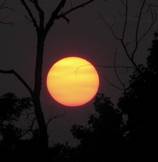
After the first day of winter, start to notice when it gets dark every day. Does the time of sunrise and sunset change? You can see how long the “day” is by recording sunrise and sunset each day. If the sunrises at 6:30 a.m. and sets at 6:30 p.m., the day length is 12 hours. Figure out the day lengths for at least 2 weeks. What do you notice?
To see this for yourself record the time of sunrise and sunset each day. If the weather is cloudy or you miss it because you were busy doing your homework, these times are often found in the weather section of your local newspaper or during the weather forecast of any local weather person.
Other family oriented science related activities
co-sponsored by the SMART-Center
12 part series “The Solar System Inside and Out”
ASTROLABE Astronomy Club meets on the third Wednesday evening of each month at 7:00 p.m. on the Second floor of the Warwood Center at 1610 Warwood Avenue, Wheeling and will host the 12 part monthly series “The Solar System Inside and Out”. The topic for December 20 is The Asteroid Belt – and the several almost planets and will offer hands-on activities appropriate for all age groups. Snacks and refreshments are provided. The series is sponsored in part by the NASA West Virginia Space Grant Consortium. After the meeting, if the sky is clear, a free public StarWatch will be held in front of the Warwood Center.
Radio Science News
If you want to learn more about science, you can tune into “Radio Science News” on WVLY 1370 AM, Saturday mornings from 11:00 a.m. to noon. “Radio Science News” immediately follows the two-hour nature program, “The Wild Side”, hosted by the regional naturalist Dr. Scott Shalaway. Robert E. Strong and Richard Pollack co-host “Radio Science News”, a local radio call-in program with a science theme.
Science in Science Fiction Club:
The “Science in Science Fiction Club” meets on the second Wednesday evening of each month at 6:00 p.m. on the Second floor of the Warwood Center at 1610 Warwood Avenue, Wheeling. Free to the public, snacks and refreshments are provided as we watch and discuss the science in science fiction movies. Check the website www.smartcenter.org for movie titles and information.
What’s Up?
Free Monthly StarWatches at Brooke Hills Park:
Free public StarWatches every third Friday evening of each month at 8:00 p.m. at Brooke Hills Park’s Clubhouse will be led by members of the ASTROLABE Astronomy Club, staff of the WLSC SMART-Center, and the Near Earth Object Foundation.
Telescopes will be provided and the public is also invited to bring their telescopes to the StarWatch events. If the weather does not permit outdoor telescope viewing, the co-presenters will give an astronomy related interactive presentation for the whole family. The StarWatches are sponsored in part by the NASA West Virginia Space Grant Consortium. Please visit www.smartcenter.org/whatsup/ for up-to-date listing of astronomy and other events.
Libby and Robert Strong and Richard Pollack work at the West Liberty State College SMART-Center and invite you to visit the SMART-Center website at www.smartcenter.org