Ohio Valley Parent article
January 2008
WLSC SMART-Center
Orion
the Hunter:
key
to the winter evening sky
Orion the hunter is one of the most easily recognized of the
officially accepted 88 constellations.
Orion is visible from almost every inhabited area on Earth.
Orion was a hero in the legends of ancient Greek mythology -
stories told for thousands of years about the adventures of heroes and the
monsters they fought. In these
legends, Orion was a giant hunter of great skill and boasting, who was placed
in the sky by the gods after his death.
What exactly is a constellation? A constellation is a sort of “connect the dots” game using
stars and a great deal of imagination.
Humans in every culture on Earth have been playing this game for
thousands of years. In modern
times, most people have adopted the official 88 constellations based on the
legends of ancient Greek mythology.
The Sun is a star - the closest star to the Earth. The Sun, often called the Daystar, is
so close we can feel its heat on our skin as it warms and lights the Earth,
drives the daily weather, and creates the yearly seasons. The nighttime stars we see on a clear
winter evening are millions of times further away.
What makes Orion unique and special for sky watchers is that
it has something interesting for almost everyone. Orion has bright stars, giant stars, stars hotter than our
Sun, and stars that are cooler.
What really makes Orion popular is that it actually looks like what it
supposed to be with out squinting and using too much imagination. Orion really looks like a person in the
sky.
Everyone has heard the nursery rhyme poem “Star light, star
bright, the first star I see tonight, I wish I may, I wish I might, have the
wish I wish tonight”. How do you
tell the difference between a bright star and a bright planet? Stars usually twinkle and planets
usually do not. Stars over our
lifetimes stay in the same patterns year after year. Planets move among the stars in paths close to the same path
that the Moon and the Sun follow.
The brightest star in the nighttime sky is Sirius the “Dog
Star” in the nearby constellation Canis Major, or the Big Dog – one of
Orion’s hunting dogs in legends.
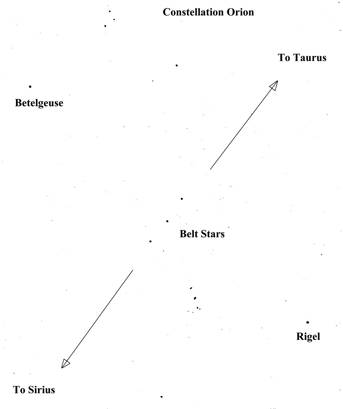
Star Hopping is a way of using the stars of one
constellation to find other stars in other constellations. Orion contains many bright stars useful
for Star Hopping to other constellations and stars.
To observe Orion and Star Hop, you will need:
1) A clear night (Moonless is best)
2) Warm clothes
3) Parents and friends to share the evening
4) The Star Hopping chart in this article
5) Binoculars, you don’t need them – but it makes it more fun (7x35 are good 7x50 are better)
The Stars of Orion:
Rigel, the brightest
star in Orion, is the left foot of Orion as he faces us. Rigel is a blue / white star much
larger, hotter, and brighter than our Sun and ranks as sixth brightest
nighttime star. It takes almost
800 years for the light from Rigel to reach us.
Betelgeuse, the
second brightest star in Orion and ninth brightest nighttime star, is 427 light
years from us. Betelgeuse is a red
supergiant star, one of the largest stars known. Betelgeuse is so huge that if we were to replace our Sun
with Betelgeuse, the orbits of the Earth, Mars, and Jupiter would still be far
inside the star.
Belt Stars, three bright
stars almost in a line.
Looking For Sirius in Canis Major:
Following the three belt stars of Orion eastward from right
to left (here in the Ohio Valley), you will discover a beautiful bright white
star, Sirius. Sirius is the
brightest star in the nighttime sky and also one of the closest stars at only
8.6 light years away. The light we
see twinkling tonight left this star eight years and seven months ago.
Looking for the face of Taurus the Bull:
Following the three belt stars of Orion westward you will
come to a V shaped cluster of stars called the Hyades Cluster, the closest
cluster of stars to the Earth.
Aldebaran appears to be the brightest star of the Hyades Cluster. Having a distinct orange color,
Aldebaran is actually 65 light years from Earth in the same direction as the
Hyades Cluster.
Looking for the Pleiades in Taurus:
If you continue in the same direction, you will come to a
second small cluster of stars.
This is not the Little Dipper, but the Pleiades cluster, a group of
stars about 440 light years from Earth.
The Japanese name for this little cluster of stars is Subaru. Next time you see a Subaru car look at
the logo – it is a small cluster of stars. The Pleiades is not one of the 88 constellations. It is a part of the constellation
Taurus and is known as an Asterism.
For more information and images of the constellation Orion, visit the website www.smartcenter/OVPM/Orion/
Robert E. Strong is the director of the West Liberty State College SMART-Center, the hands-on science center of the Northern Ohio Valley. Libby Strong is the Program Coordinator at the West Liberty State College SMART-Center and also directs the WV-Handle On Science Program that brings hands-on science kits to the public school classrooms of the Northern Panhandle. Richard Pollack is the assistant program coordinator, webmaster, and technology specialist for the WLSC SMART-Center. Robert, Libby, and Richard invite you to visit the website at www.smartcenter.org